No Mirrors, No Memberships: Inside Philly's Raw, Radical Fitness Underground
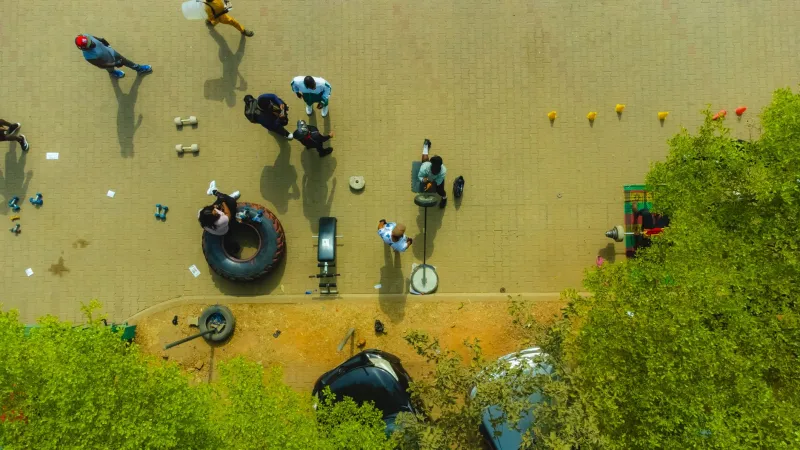
It's 6 a.m. on a Saturday in Hunting Park, and about thirty people are doing burpees in a parking lot. There's a Bluetooth speaker blasting a playlist that swings between Afrobeats and old-school Philly soul. Someone's laughing so hard they can barely finish a set. Nobody's wearing matching gear. Nobody's tracking their macros on an app. And somehow, this is the best workout any of them will have all week.
This is the other Philadelphia fitness scene — the one that doesn't show up in listicles about the city's best gyms, doesn't have a sleek app, and doesn't care what your resting heart rate is. It's a growing network of grassroots communities that have decided sweating together is less about optimization and more about something harder to quantify: showing up, connecting, and building something human in a city that can sometimes feel overwhelming.
The Warehouse Bootcamp That Became a Movement
Step inside the space that Marcus Webb runs in a converted Kensington warehouse on Thursday nights, and you'll understand immediately why people drive across the city to be here. The walls are exposed brick. The floor is painted concrete. The equipment is a mix of donated gear, DIY builds, and whatever showed up in the van after last weekend's flea market run.
Webb, 34, started what he calls "The Yard" three years ago after getting priced out of a lease on a more traditional training space. "I was pissed at first," he admits, adjusting a tire that functions as both an obstacle and a seat. "Then I realized the warehouse was better. Less pressure to make it look like something. More pressure to make it feel like something."
The Yard runs on a pay-what-you-can model. Some nights that means Webb breaks even. Some nights he doesn't. But the community that's formed around the Thursday sessions — which regularly draw 40 to 60 people — has taken on a life of its own. Members organize cookouts, show up for each other at rough moments, and have collectively become something resembling an extended family.
"I've had people come in here fresh out of a breakup, fresh out of a job loss, fresh out of a hospital," Webb says. "They're not here because they want a six-pack. They're here because they need to be around people who are going to push them. That's what we do."
Street Dance as Cardio, Community as Curriculum
Over in West Philly, a collective called Floor Work has been running free outdoor dance fitness sessions in Clark Park since 2021. What started as a pandemic-era experiment — a way to move together when gyms were closed and isolation was crushing — has grown into one of the neighborhood's most beloved recurring events.
Founder Kezia Morales, a trained dancer and former fitness instructor, was frustrated by what she saw as the fitness industry's narrow definition of what a body should look like and what movement should feel like. "The gym always felt like a place where you were being evaluated," she says, watching a group of about twenty people work through a hip-hop-inflected warm-up. "Out here, it feels like play. And play is actually really good exercise."
Floor Work sessions blend house dance footwork, stretching, and full-body cardio into something that looks less like a class and more like a really good time at a house party. The playlist is curated with the same care as a DJ set. The vibe is intentionally non-competitive. "I tell people: the only person you're racing is who you were when you walked in," Morales says.
The sessions draw a genuinely mixed crowd — ages, body types, fitness levels, backgrounds. That's not an accident. It's the whole design.
The Gym That Doesn't Feel Like a Gym
Tucked behind a barbershop in South Philly, Cornerstone Boxing has been operating for almost a decade out of a space that has precisely zero amenities beyond a ring, some heavy bags, and a wall of mirrors that someone hung at a slightly crooked angle and never bothered to fix. It's perfect.
Head trainer Darius Cole runs the gym with a philosophy borrowed as much from community organizing as from boxing. Membership is sliding scale. Kids from the neighborhood train for free. And the culture Cole has cultivated is relentlessly focused on discipline, mutual respect, and showing up — for yourself and for whoever's standing next to you.
"Boxing gyms used to be community institutions," Cole says, wrapping someone's hands before a sparring session. "They were places where neighborhoods worked things out. Where kids had somewhere to go. We're trying to hold onto that, because that model is disappearing."
Cornerstone doesn't have an Instagram presence to speak of. It doesn't run promotions. It survives on word of mouth and on the loyalty of people who found it when they needed it most. On any given evening, the room holds teenagers doing footwork drills, a 55-year-old accountant working the speed bag, and a group of women who started a beginner's class six months ago and haven't missed a week.
Pop-Up Yoga and the Politics of Stillness
Not every entry in Philly's alternative wellness scene involves someone getting punched or screaming through a circuit. On Sunday mornings in Fairmount Park, a rotating collective of yoga teachers and meditation facilitators runs free sessions under the name Still Moving — and their approach carries its own kind of radical energy.
Organizer Priya Nair started the collective after noticing that the wellness industry, for all its talk of accessibility, remained stubbornly expensive and culturally narrow. "A yoga class in Center City can run $30, $35 a session," she says. "That's not a community resource. That's a luxury product with community language painted on it."
Still Moving operates entirely on donations and volunteer teaching. Sessions are bilingual when possible. Props and mats are available for anyone who doesn't have their own. And the conversations that happen before and after class — on blankets in the grass, sharing snacks, watching the park come alive — are, Nair insists, as important as anything that happens during the practice itself.
"Wellness isn't a commodity," she says. "It's something you build together. The fitness industry wants you to think you can buy it. We're out here proving you can't."
Why This Matters Beyond the Workout
There's a reason these communities are growing while traditional gym memberships fluctuate with every economic shift. They're offering something the fitness industry fundamentally cannot: genuine human connection built around shared effort and shared space.
In a city where loneliness is a documented public health concern and economic pressure makes community-building harder every year, spaces like The Yard, Floor Work, Cornerstone, and Still Moving are doing something genuinely important. They're creating the conditions for people to know each other — really know each other — in a way that a spin class or a Peloton subscription will never replicate.
The sweat is real. But it's almost incidental. What these communities are producing, session by session and Saturday by Saturday, is a version of Philadelphia that takes care of its own.