Scrambled at 3 A.M.: The New All-Night Eateries Feeding Philly's After-Hours Faithful
Hunger Doesn't Keep Business Hours
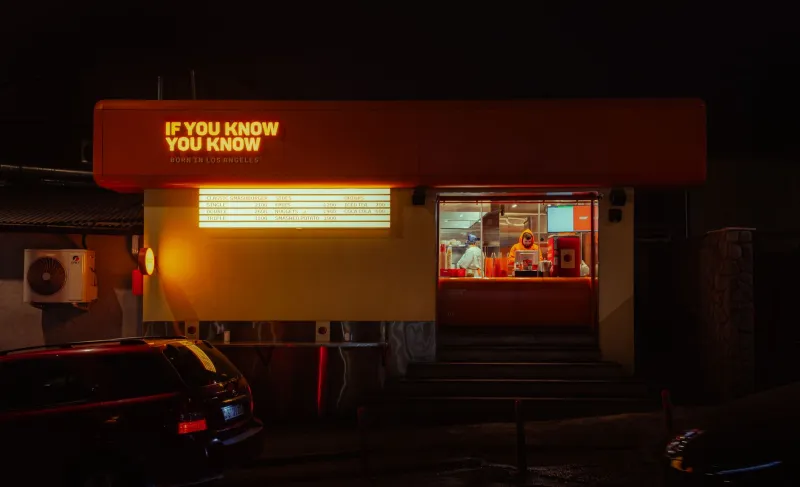
It's 3:17 in the morning and the line outside a narrow storefront in West Philadelphia stretches half a block. This is not a club. There's no velvet rope, no dress code, no cover. There is, however, the smell of caramelized onions and smoked meat drifting out every time the door opens, and that smell is doing all the marketing anyone could ever need.
Inside, a crew of four is running a tight, loud, beautiful kitchen. Breakfast plates are going out. A short-rib hash is almost sold out. Someone just ordered the jerk chicken and waffles for the third time tonight. The owner — a compact woman named Renee Ashford who worked hospital cafeteria shifts for six years before opening this place — looks exhausted and completely at peace.
"I knew there was a market," she says, sliding a plate onto the pickup counter without breaking stride. "I lived this life. I was this customer. Nobody was feeding us."
Ashford's spot, Midnight Plate, is part of a quiet but undeniable shift happening in Philadelphia's food landscape. A new wave of entrepreneurs is opening restaurants, pop-ups, and hybrid concepts specifically designed for the hours when most of the city has gone dark — and discovering that the demand is enormous, the competition is thin, and the community that forms around these spaces is unlike anything the daytime restaurant world produces.
Who's Actually Eating at 4 A.M.?
The popular image of the late-night food customer is someone stumbling out of a bar, craving grease and carbs. And sure, that person exists and they deserve to eat well too. But the actual customer base for Philly's emerging all-night eateries is far more diverse and far more interesting.
There are the shift workers — nurses, security guards, transit operators, warehouse employees, hotel staff — who get off work at 11 p.m. or 2 a.m. or 6 a.m. and have nowhere decent to eat before or after their shifts. There are the creatives — musicians, producers, visual artists — who work through the night and need fuel. There are the insomniacs, the jet-lagged, the anxious. There are families in neighborhoods where late-night food options have historically meant fast food or nothing.
"My regulars at 2 a.m. are not who people expect," says Marcus Lin, who runs an all-night noodle and dumpling counter in South Philly called Slow Burn. "I've got a SEPTA driver who comes in every night after his shift. A nurse from Jefferson. A guy who does overnight security at a museum. These are working people. Serious people. They want real food."
Lin opened Slow Burn 18 months ago after years of watching the late-night food desert in his neighborhood up close. He works the overnight himself four nights a week, which he says is the only way to understand what the service actually demands.
Menus Built for the Night
What these new spots are serving reflects a thoughtful recalibration of what late-night food can be. Gone is the assumption that exhausted or post-party customers just want something quick and forgettable. The new model leans into comfort, quality, and specificity.
At Midnight Plate, the menu is built around elevated breakfast-all-day fare — thick-cut French toast with whipped honey butter, shrimp and grits with a smoked tomato gravy, a rotating hash that changes based on what Ashford finds at the Reading Terminal Market earlier in the week. Nothing is precious or fussy. Everything is built to satisfy.
Slow Burn's menu is deliberately short — six noodle dishes, four dumpling varieties, two rotating specials — but executed with the kind of care that most full-service restaurants reserve for dinner service. Lin makes his own chili oil. The broth for the beef noodle soup simmers for 18 hours.
Over in Kensington, a new spot called The Third Shift has taken a different approach: a rotating menu of globally inspired small plates, with an emphasis on the kind of food that the neighborhood's large immigrant community actually eats at home. Pupusas. Oxtail. Fufu. Birria. The owner, a first-generation Honduran-American named Sofia Reyes, describes it as "the restaurant I always wanted to find when I was working doubles at the hospital."
The Business of Being Open When Everyone Else Is Closed
Running an all-night eatery is not for the faint of heart. The operational challenges are real: staffing is brutal (finding reliable employees willing to work overnight shifts is one of the most consistent complaints), food cost management requires different thinking than a traditional restaurant, and the customer experience can be unpredictable in ways that daylight hours rarely produce.
But the economics, for operators who get it right, can be surprisingly strong. Rent for late-night-friendly spaces — often in less trafficked commercial corridors — tends to run lower than prime daytime real estate. Competition is minimal. And the regulars who find a spot they trust become extraordinarily loyal.
"My daytime customers are customers," Ashford says. "My overnight regulars are family. They tip well, they refer their friends, they come back three times a week. You can't buy that kind of loyalty."
Several operators have also found creative ways to layer revenue streams. Midnight Plate does a brisk catering business for hospitals and call centers. Slow Burn sells its chili oil and sauces at a handful of local shops. The Third Shift hosts a Sunday afternoon pop-up that draws a completely different crowd than its overnight clientele.
A Different Kind of Third Place
Beyond the food and the business models, what's most striking about Philly's late-night eating scene is what these spaces mean to the people who use them. In a city where the social geography can feel sharply divided by neighborhood, class, and time of day, the all-night eatery functions as something genuinely rare: a place where different slices of the city end up at the same table.
On any given night at Midnight Plate, you might find a table of nurses still in scrubs, a group of twentysomethings coming down from a night out, a solo regular with a book and a standing order, and a couple who just got off a late shift at a hotel downtown. The food is the common language. The hour is the shared experience.
"There's something about 3 in the morning that makes people real," Ashford says, watching the room from behind the counter. "The pretense is gone. People are just hungry and tired and human. I love that. That's the version of Philly I want to feed."
The city, it turns out, is hungry for exactly that.