When the City Sleeps, They Clock In: The Invisible Workforce Powering Philly After Dark
Darnell gets to the venue at 11 PM, but his shift doesn't really start until 2. That's when the energy in the room shifts — when the casual drinkers have gone home and the people who are genuinely committed to the night are all that's left. He's worked security at the same spot in Fishtown for six years. He knows the difference between a crowd that's having fun and a crowd that's about to become a situation. "You can feel it," he says, leaning against the wall near the side entrance, arms crossed, eyes scanning. "It's like a pressure change. You just know."
Darnell is part of an economy that most Philadelphians interact with constantly and think about almost never. The 3 AM economy — the sprawling, informal, surprisingly tight-knit network of workers who keep the city's nightlife infrastructure alive after the rest of the world has logged off — is one of the most culturally significant and least celebrated labor ecosystems in the city. These are the people who make the night possible. And most of us have no idea what their world actually looks like.
Clocking In When Everyone Else Clocks Out
The late-night service industry in Philadelphia isn't a monolith. It's a layered thing — security staff, kitchen crews, DJs, event coordinators, cleaning teams, bartenders pulling doubles, parking lot attendants, and the rotating cast of fixers and runners who handle the hundred small crises that erupt between midnight and sunrise. Each of these roles has its own rhythms, its own culture, its own unwritten rules.
What they share is a relationship with time that most people find disorienting. "My friends don't really get my schedule," says Maya, who coordinates events at a nightclub in Old City and typically wraps her shift somewhere between 4 and 5 AM. "They'll text me at noon like, 'You up?' And I'm like — I've been asleep for three hours. Give me a minute." She laughs, but there's something genuine underneath it. The late-night schedule isn't just logistically different. It creates a kind of parallel social life, a community of people who operate in a time zone that doesn't have a name.
The Kitchen Never Really Closes
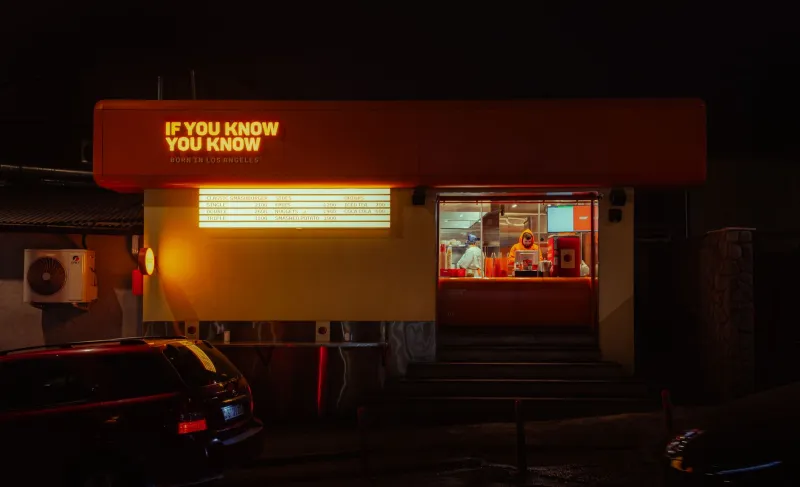
In the back of a late-night spot in South Philly, a kitchen crew is moving through the post-midnight rush with the focused efficiency of people who've done this a thousand times. The orders are different at 2 AM than they are at 8 PM — simpler, faster, higher volume. The cooks here aren't working the glamour shift. They're working the shift that nobody sees.
"People think the kitchen closes when the restaurant closes," says one line cook who's worked late-night food service in Philly for four years. "But somebody's gotta be here when the clubs let out. Somebody's gotta make that food." He wipes his hands on his apron and checks the tickets. There are twelve of them. It's 2:47 AM.
The late-night kitchen is its own subculture. The humor is darker, the pace is faster, the tolerance for nonsense is lower. But so is the pretension. "Nobody back here is trying to be on TV," the cook says. "We're just trying to get through the night and make sure people eat something before they get in a cab."
The DJ as Urban Architect
If the kitchen is the engine of the late-night economy, the DJ booth is something closer to its nervous system. In Philadelphia's club and bar scene, the DJ isn't just providing background noise — they're actively managing the emotional temperature of a room, making split-second decisions about when to push the energy and when to let it breathe.
"People don't realize how much work goes into making it look effortless," says DJ Renée, who's been playing late-night sets across the city for eight years, working rooms from West Philly to the waterfront. "You're reading two hundred people at once. You're watching the dance floor, watching the bar, watching the door. It's not just music. It's crowd psychology."
Renée describes the hours between 1 and 3 AM as the most technically demanding part of any set. "That's when you either lose the room or you lock it in. There's no middle. And once you lose it, you don't get it back." She's built a reputation in Philly's nightlife scene specifically for her ability to navigate that window — for knowing, almost instinctively, which record to play when the energy starts to wobble.
The Unwritten Rules
Every late-night worker interviewed for this piece mentioned, in some form, the existence of a code. Not a formal one — nothing written down anywhere. But a set of shared understandings that govern how the 3 AM economy actually functions.
You look out for the people you work with. You don't leave before the job is done, even if your official shift ended an hour ago. You don't bring personal drama into a space that's already managing enough of it. And you treat the people doing the jobs below yours on the visible hierarchy with the same respect you'd want if the roles were reversed.
"We all know each other," says Darnell. "The security guys, the bartenders, the cleaning crews — everybody knows everybody. You see the same faces every weekend for years. That becomes something." He pauses. "It becomes family, kind of. You don't say that out loud, but it is."
This informal solidarity is the social infrastructure underneath the economic one. It's what allows a 3 AM crisis — a medical situation, a fight, a kitchen disaster — to get handled quickly and quietly, without the whole night falling apart.
What the Night Costs
None of this comes without a price. The late-night schedule is hard on bodies and harder on relationships. Healthcare access for hourly nightlife workers is inconsistent at best. The emotional labor of managing intoxicated strangers for six-hour stretches takes a toll that doesn't show up on any pay stub.
And yet the people who do this work talk about it with something that sounds a lot like pride. Not the performed kind. The real kind — the satisfaction of being good at something difficult, of being part of a community that functions precisely because everyone in it understands their role.
"Philly's nightlife has a reputation," says Maya, gathering her things as the venue empties out around her. "People come here because they know it's gonna be real. That doesn't happen by accident. Somebody's making that happen every single night." She looks around the room — sticky floors, dim lights, the last few stragglers heading for the door. "It's us. We're making that happen."
By 4:30 AM, the cleaning crew has arrived. The night is over. The work is just beginning.