Living Rooms with Boards: How Philly's Small Venues Became the New Recording Studio
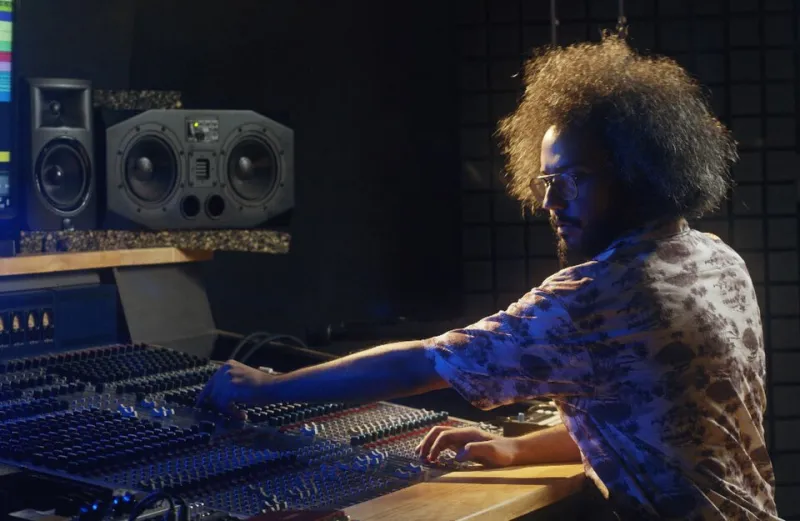
Photo: Unknown, CC0, via Wikimedia Commons
There's a moment, if you've ever stood in the right room at the right time in this city, where the line between performance and production completely dissolves. The stage is still warm from the last set. A producer is hunched over a laptop in the corner. An artist is running the same eight bars through the PA again, listening to how the room responds. Nobody's performing for an audience. They're building something.
This is the new Philadelphia sound check — and it's happening in bars, basements, and converted warehouse spaces all across the city.
The Room as an Instrument
Ask any working producer in Philly and they'll tell you the same thing: rooms have personalities. The low ceiling of a Fishtown dive gives you a compression you can't fake in post. The brick walls of a South Philly venue scatter frequencies in ways that feel lived-in, organic, almost human. And increasingly, the people who run these spaces are leaning into that reality on purpose.
"I started letting artists come in on off-nights just to see what would happen," says one venue operator in Kensington who's been running a 120-capacity room for the better part of a decade. "What happened was they started making records. Like, actual records. Right here on our stage."
He's not exaggerating. Over the past two years, his space has quietly hosted tracking sessions, vocal overdubs, and full band recordings for artists who couldn't afford traditional studio time — or simply didn't want it. The vibe of a real room, they argued, was worth more than the clinical perfection of a soundproofed booth.
It's a philosophy that's spreading fast.
Production in the Wild
The economics make a certain kind of sense. Studio time in Philadelphia — even at the more accessible mid-tier spots — can run anywhere from $50 to $150 an hour. For an emerging artist trying to record a six-song EP, that math gets ugly quickly. Venues, on the other hand, sit dark three or four nights a week. Their PA systems, lighting rigs, and acoustic quirks are already paid for.
What's emerging is an informal but increasingly organized network of venue-studio hybrids that are reshaping how local artists develop their craft. Some spaces are formalizing the arrangement — offering booking packages that include off-hours studio access. Others keep it loose, operating on handshake deals and shared community goodwill.
Producers are adapting accordingly. "I used to think I needed a specific setup to get the right sound," says one North Philly beatmaker who's been producing in venue spaces for the past three years. "Now I think the setup IS the sound. I'm not fighting the room anymore. I'm collaborating with it."
That shift in mindset — from controlling acoustics to working with them — is producing music that sounds distinctly different from what's coming out of traditional studios. There's a rawness to it, a spatial quality that listeners are responding to even if they can't articulate why.
Where Live Performance Meets the Lab
Some of the most interesting experiments are happening at the intersection of audience and creation. A handful of Philly venues have started hosting what they're calling "open sessions" — ticketed events where artists record live, in real time, with audiences present. The crowd becomes part of the sonic environment. Their energy, their noise, their collective breathing gets captured on tape.
It sounds gimmicky until you actually experience one. The pressure of a live room changes how musicians perform. There's no punching in to fix a bad note. No infinite takes. What you play is what you get, and that constraint — that beautiful, terrifying constraint — has a way of producing performances that feel genuinely alive.
"You can hear the difference," says one recording engineer who's worked both traditional and venue sessions. "When someone's playing for a room full of people, even thirty people, something opens up in them. You capture that. You can't fake it."
The Community Infrastructure Behind the Sound
None of this is happening in a vacuum. Philly has always had a culture of creative resource-sharing — from the co-op model of its visual arts community to the collaborative ethos of its hip-hop scene. What's new is how that culture is being formalized into something that looks, from a distance, like a genuine alternative infrastructure for music production.
Venue owners are connecting with local engineers and producers to build in-house capabilities. Artists are pooling resources to buy shared equipment that lives at a venue instead of in someone's bedroom closet. Mentorship is flowing in both directions — older producers teaching emerging artists, younger artists bringing new technical knowledge back into spaces that have been running the same analog setup for fifteen years.
The city's music ecosystem, which has always been stubbornly independent, is building something that doesn't need to ask permission from the industry to exist.
What This Means for the Philly Sound
It's too early to call it a movement with a capital M. But the pieces are assembling themselves into something coherent. Philadelphia has always punched above its weight musically — from the soul orchestrations of the 1970s to the hardcore and punk scenes of the '80s and '90s to the current generation of artists making noise nationally and internationally. Each era had its defining spaces, its defining sounds.
The venues-as-studios shift might be the thing that defines this one. Not a genre, exactly, but a methodology. A way of making music that's rooted in the city's physical spaces, its economic realities, and its persistent refusal to wait for someone else to build the infrastructure it needs.
The boards are live. The rooms are ready. Philly's already recording.